Translate

Monday, October 7, 2013

El uso político de la justicia

El objetivo final de muchos gobernantes en América latina es permanecer ilimitadamente en el poder

Desde fines de los años 90 hasta la fecha muchos gobernantes en América Latina han ido elaborando un modelo político cuyo objetivo final es permanecer ilimitadamente en el poder. Si bien utilizan la palabra “democracia” como bandera y el voto popular para llegar al gobierno, una vez elegidos, reforman sus Constituciones y destruyen sus sistemas judiciales para controlarlos. El control de estos gobiernos sobre el sistema judicial es quizás la pieza clave que necesitan para perpetuarse en el poder. Controlando la justicia pueden silenciar a la prensa, ocultar la corrupción y perseguir a la oposición. Quizás uno de los casos más representativos es el Ecuatoriano.
El 21 de Septiembre pasado, durante una cadena nacional, el presidente de Ecuador Rafael Correa rompió en vivo ejemplares de los diarios El Comercio, La Hora y Hoy, y les advirtió que de acuerdo a la nueva ley de comunicaciones, ellos están obligados a “publicar noticias de interés público”. Durante el mismo programa, continuó atacando y descalificando a cada uno de los columnistas que en esa semana habían publicado críticas en su contra, obligándolos a rectificarse. De no rectificarse, Correa hará lo que ya ha hecho reiteradamente en el pasado: amenazar a los medios con quitar pauta oficial, o abrir investigaciones contra los propios auspiciantes de estos medios hasta que el periódico se rectifique o el periodista que escribió la columna sea despedido. Y si esto no funciona, Correa perseguirá judicialmente a estos medios, imponiéndoles sanciones millonarias.
Durante el mes de Junio, diferentes medios publicaron noticias sobre una presunta mega operación de lavado de dinero entre Venezuela y Ecuador a través del sistema monetario conocido como “SUCRE” (Sistema Único de Compensación Regional). Producto de dichas publicaciones, la fiscalía ecuatoriana abrió una investigación sobre 4 empresas involucradas en el lavado. Sin embargo, la investigación sobre una de ellas llamada “Fondo Global” nunca prosperó, presuntamente por los lazos de sus propietarios con funcionarios de los gobiernos de Ecuador y Venezuela. Al día de hoy no hay indicios que la justicia proceda a fondo con estos casos. Las operaciones de lavado de dinero y exportaciones ficticias entre ambos países continúan.
Mery Zamora, dirigente del Movimiento Popular Democrático (MPD), fue sentenciada tiempo atrás por un tribunal de primera instancia a 8 años de prisión por el delito de sabotaje por incitar una protesta estudiantil durante el 30 de Septiembre de 2010, mientras se desarrollaba una protesta policial en contra del gobierno. Esta decisión no es más que otra muestra de persecución política contra un grupo abiertamente opositor. El fallo fue apelado por sus abogados. Sin embargo, el juez de segunda instancia a quién le toco el caso, es ni más ni menos que Gutemberg Vera, abogado personal de Rafael Correa en su juicio contra el diario El Universo.
Estos son solo algunos ejemplos que sirven para mostrar como el Gobierno de Rafael Correa utiliza el sistema judicial arbitrariamente para silenciar periodistas, ocultar posibles casos de corrupción en los cuales altos funcionarios podrían estar involucrados, y perseguir a aquellos ecuatorianos que alzan la voz y critican al gobierno.
Pero este control del sistema judicial no ocurrió de la noche a la mañana, si no que fuer parte de un plan deliberado. En Mayo de 2011, Rafael Correa convocó un referéndum para reestructurar la Corte Suprema. A través del mismo, creo un nuevo sistema de selección de jueces, el cual en última instancia estaría controlado por el Ejecutivo. Hoy en día, la gran mayoría de los nuevos jueces elegidos a través de este nuevo mecanismo son o ex funcionarios de su gabinete, o parientes de funcionarios, o jueces que han estado involucrados en decisiones controversiales a favor de los intereses del gobierno. Desde entonces, es prácticamente imposible encontrar una sentencia judicial que perjudique los intereses de Rafael Correa.
En Ecuador, las libertades civiles de las personas se esfuman día a día y cada vez se hace más difícil hacer oposición. El miedo reina entre aquellos que quieren opinar diferente. Todo esto ocurre por que la herramienta fundamental para el funcionamiento de una Democracia Constitucional, el sistema judicial, ha sido destruida y es utilizada no como herramienta de justicia, si no de persecución.
 Ezequiel Vázquez-Ger es consultor político basado en Washington DC. Twitter: @ezequielvazquez


Friday, October 4, 2013

SAIL TECH BY THE OLD MASTERS

Why Mast Rake?

by Reuel Parker

Three-masted Chinese Junk
A LORCHA sail plan, based on 16th-century Chinese/Portuguese technology.
A common question people ask me is why masts are raked, and why, in many instances, they are raked differently. In ocean-sailing three-masted Chinese Junks, for example, the main mast is often nearly vertical, but the fore and mizzen masts rake strongly away from the main.
The simple answer (really evading the question) is that it’s traditional, and that it looks good. If you look at drawings, paintings and many surviving historical vessels, particularly from times previous to the mid-nineteenth century, you will note strong mast rake. A common factor among most of these vessels is the absence of standing rigging—the masts are usually free-standing.
To begin with: Because the primary vector of sail drive is forward, the overhanging weight of an aft-raked mast helps counter-balance this vector. If a jib is employed, this mast weight helps provide luff-tension. Because a raked mast bends aft, luff-tension will straighten it, whereas a vertical mast would bend forward, compromising mains’l shape. Thus: Cantilevered mast weight aft counters sail drive forward and helps tension forestays. Free-standing raked masts can also be “curved” (bent aft) more easily to flatten sails when sheeting in, creating a smaller sail chord when beating to windward. Many modern “go-fast” racing sailboats use hydraulic backstays to achieve this, when traditional vessels with free-standing masts simply used the main sheet. It is theorized that the raked sail luffs even provide a small “vertical lift” vector, but I personally doubt the effectiveness of this, except possibly on ultralights.
Crabbing skiff
A 16′ Eastern Shore Stick-up crabbing skiff.
Some masts are raked strongly forward. Examples include Chinese Junks, New York Harbor lighters (called “periaguas”), and Chesapeake Bay log canoes and crabbing skiffs, the Eastern Shore “Stick-up” being an example.
This unlikely-looking sail plan has unique and unanticipated properties: first, the mast steps and partners are out of the cockpit or fish hold; second, the large gap between sails allows them to function independently of each other when close-reaching or beating; and third, the fores’l is “self-selecting”—it will automatically jibe to the most effective side—when sailing off the wind. Marine historian Howard Chapelle noted that it was claimed that stick-ups could work to windward in very strong winds under fores’l alone, something which seemed theoretically impossible!
Independent of the free-standing factor, mast rake provides longer sail luff length without equivalent vertical mast height & weight aloft (including heads’l luffs especially). This translates to more sail power for less weight and windage aloft, and results in all-around improved performance.
Sails “hang” from a raked mast instead of wanting to collapse against it—consequently providing better sail shape, particularly if the sail is boomless. Flatter sails & better shape are also due to longer sheet-lead angles, especially for overlapping (boomless or lug-rigged) foresails. And sails, with or without booms, automatically swing to the deck centerline for easier furling & reefing. This may also make for easier jibing.
Virginia Pilot Schooner
A 45′ Virginia Pilot Schooner based on Isaac Webb’s DREAM from 1833.
In schooners with boomless foremasts, halyards hang well aft of the mast base, and can be used to lift cargo and launch boats more easily, swinging clear of masts & rigging. The consequent location of mast-partner and -step further forwardfrees up critical deck, cargo hold and cabin space, and provides awider shroud base in some instances. This last item is especially valid when using halyards as temporary backstays—a common practice on vessels with free-standing masts.
A critical consequence of a raked mast is the more “acute angle” between mast and boom. Boom-ends are thereby elevated off the waterwhen reaching and running, and are less likely to trip, or break, in large seas. This is particularly true for schooners with long overhanging main booms. And most vessels with strongly raked masts have less pitching motion, because mast center-of-gravity is located further aft, above the hull’s location of maximum buoyancy.
Virginia Pilot Schooner
A 33′ Chesapeake Bay BROGAN, adapted from early 19th century Oyster
Boats.
A final added advantage of sails on raked masts is that they can be more easily lowered when running off the wind, due to the wind helping to push them down. This is even more effective if the masts are free-standing.
As for why masts are raked differently, almost any yacht designer will tell you that parallel masts appear to be converging, visually, and should always diverge slightly to avoid this. The Herreshoffs, in particular, made this clear in their writings.
An excellent contemporary example of a strongly raked mast may be seen on the ocean-racing catamaran ENZA (Eat New Zealand Apples), which won the original Jules Verne Around the World Trophy. The mast rake was actually a consequence of lengthening the original cat without relocating her mast step… but her crew came to believe that the strongly raked mast made her faster and easier to sail… and it does look good!

250 Megawatt Moapa Solar Project


Blog Thumbnail

250 Megawatt Moapa Solar Project Purchased by First Solar


The 250 megawatt solar farm that the Moapa Band of Paiutes are building on tribal property was purchased by First Solar last week from K Road Power Holdings. The project is the first utility-scale solar project on a Native American reservation. 
The Moapa Solar Project was first announced by K Road Power in June 2012. However, when it was first announced, the solar farm was planned as one totaling up to 350 megawatts. The smaller solar project will be constructed 2,000 acres of Moapa land in Clark County, northeast of Las Vegas, Nev. The Moapa are building the project even as a coal fired power plant—which has caused innumerable health issues for members of the tribe—is set to close. A mock up of the Moapa Solar Project. Courtesy BLM.
"K Road is pleased to announce the launch of this pioneering project, and grateful for the stalwart support of our key partners and stakeholders, the Moapa Tribe, the federal and state agencies, and the IBEW. These folks have played an invaluable role in helping bring this novel project to the eve of construction," said K Road CEO William Kriegel. "First Solar's deep experience and proven capabilities will ensure that the project is expeditiously completed to the highest standard, while carefully considering the interests of all stakeholders."
Under the new agreement, First Solar will design and build the solar project, which will use its Cadmium Telluride (CdTe) thin film solar modules. "First Solar is proud to participate in this landmark project on lands where it can benefit the economic development of the Moapa Paiute tribe and serve clean energy to the City of Los Angeles," said Jim Hughes, First Solar CEO. "We're excited to build on the foundation and hard work of K Road and so many key stakeholders to make this project a reality, establishing a significant source of clean, renewable energy for the region."
The project received approval from the Department of Indian Affairs and Department of the Interior last year. K Road signed a 50-year lease with the Moapa Band of Paiutes. And the project already has a 25-year power-purchase agreement with the Los Angeles Department of Water and Power (LADWP) for the power that the solar plant produces. 
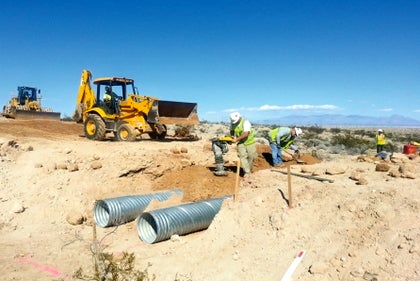
Already, the initial construction and the relocation of desert tortoise species have begun at the site. First Solar said the project could be completed by the end of 2015. During the peak of construction, the project is anticipated to create up to 400 jobs. This coincides with K Road's initial plant to help increase tribal employment through training members of the Moapa band of Paiutes with training. Once the solar farm is finished, it will provide 10 permanent positions. 
K Road is also hopeful that this project will help foster interest in future renewable energy projects on tribal lands. This is beginning to happen, as the Native American tribe recently signed an agreement with Herbst Energy and Stronghold to develop up to 1.5 gigawatts of clean energy on its lands. 

Thursday, October 3, 2013

La llama, el nuevo guardián

La llama, nuevo guardián de los rebaños de ovejas en las montañas de Suiza

El carácter atento y curioso de estos camélidos andinos, y su comportamiento en el terreno, similar al de los perros y asnos, son algunas de sus ventajas
La llama, nuevo guardián de los rebaños de ovejas en las montañas de Suiza
Las llamas reemplazan a perros y asnos en la vigilancia de los rebaños de ovejas en Suiza. (Imagen referencial / AP)

Ginebra (EFE). Tras generaciones de hegemonía del perro y el asno como guardianes de los rebaños de ovejas en los Alpes de Suiza, los pastores locales han encontrado en la llama, camélido oriundo de los Andes, un nuevo aliado contra los ataques de lobos y linces.
El carácter atento y curioso de estos camélidos andinos, y su comportamiento en el terreno, similar al de los perros y los asnos son algunas de sus ventajas, según los ganaderos.
FASE DE PRUEBA
Bajo esta perspectiva, la Asociación Suiza para el Desarrollo de la Agricultura y del Espacio Rural (Agridea) ha decidido utilizarlos en una fase de prueba y empezado con veinte ejemplares que protegen actualmente algunos rebaños.
Agridea se ha inspirado en el testimonio positivo de Estados Unidos y Australia, donde estos animales se emplean desde hace bastante tiempo para evitar que los coyotes o los perros callejeros ataquen al ganado.
“Hemos decidido experimentar con las llamas en pastos pequeños donde la presión del lobo, aunque existe, es menor. Además, son animales con gastos de mantenimiento muy pequeños”, declaró Daniel Mettler, responsable de los dos proyectos pilotos con llamas que Agridea lleva a cabo en Suiza.
EL CASO DE ‘LUSKO’
El propio presidente de la Federación Suiza de Ganado Ovino y propietario de más de sesenta ovejas, German Schmutz, decidió experimentar con una llama, a la que decidió llamar “Lusko”.
A “Lusko” se le encargó proteger a más de 250 ovejas que unos 30 pastores pasearon este verano por los pastos del valle de Petit-Mont en Gruyère (Cantón de Friburgo).
“Al principio fue bastante difícil porque el camélido se mostraba muy agresivo, pero ahora todo va mucho mejor y se ha vuelto más calmado. Con 250 ovejas hembras… ¡Tiene de que ocuparse!”, bromeó el pastor Schmutz.
Consideró que una ventaja de la llama es que, contrariamente a lo ocurre con los canes, no ladran cada vez que pasa alguien por su lado.
Mettler corroboró que los camélidos tienen un escaso riesgo de provocar un conflicto con otros animales o con personas, especialmente turistas.
“Decidimos probar la experiencia después de la proposición de Agridea de emplear a “Lusko”. Más vale probar cualquier cosa que no hacer nada. Algunos (pastores) están en contra sólo porque nunca se ha hecho”, comentó el pastor.
FÁCIL DE ALIMENTAR
Por otra parte, otro pastor y dueño de unas decenas de ovejas, Hubert Tinguely, señaló que alimentar a la llama es más simple porque come hierba como las ovejas, mientras que a los perros hay que darles otro tipo de comida.
Además, la llama, que es el pariente sudamericano del camello, necesita poca agua.
Se le ha considerado un animal muy fuerte que fue domesticado por los habitantes de los Andes y durante siglos la población indígena los usó como animales de carga.
¿Y LOS DEPREDADORES?
En relación a los ataques de lobos, Tinguely dudó de que fuesen una verdadera amenaza en sus pastos aunque estos animales reaparecieron en Suiza en los años noventa y en los últimos años se ha informado de varios ataques a rebaños.
“En esta zona tenemos la suerte de que no hay matorrales donde los depredadores puedan esconderse y los pastos están todo el día a pleno sol”, afirmó.
El futuro de las llamas dependerá de la evolución del pastoreo en Suiza, ya que su uso responde a circunstancias específicas, que son la de pastos pequeños y una menor presión del lobo.
“Con las llamas estamos en fase de pruebas. Los perros siguen siendo elementos clave en la defensa contra los depredadores, pero los camélidos son una alternativa”, concluyó Mettler.

GOOGLE WEB DESIGNER


PATRULLEROS INTELIGENTES¿Policia Inteligente?

Para que la el Perú tenga Seguridad ciudadana se debe de contar con una Policía Profesional, empezar por las escuelas, por las universidades y con cursos de Ley y Orden, de Seguridad Ciudadana, cursos de Leyes de Transito y manejo... donde los alumnos aprendan a hacer "lo que es correcto" "Lo que uno  debe de hacer y cómo comportarse de acuerdo a la ley" para formar un ciudadanía que sea educada y correcta. Para que la Policía sea una Policía profesional se tienen que enseñar en las Universidades los cursos para ser Policía


Este curso esla solución pára que el Perú


 cuente con  una policía profesional


     ACADEMIA POLICIAL PROFESIONAL 

           HOMELAND SECURITY PERU

Challenge your brain and career with scientifically-designed training with The new "Law enforcement program for Peruvian studies" for local schools and Universities

Personalized Training Program

  • Train students on law awareness and law enforcement courses to develop a profesional police force
  • Web-based personalized training program and local University state of the art classes
  • Track your progress and apply it to create a professional police force and apply to local police graduates


Criminal Justice (CRJ) Course Descriptions

Department of Criminal Justice, College of Public Policy


CRJ 1113  The American Criminal Justice System [TCCN: CRIJ 1301.]
(3-0) 3 hours credit.
Philosophy and history of criminal justice in America; examination of criminal justice agencies operating as an interacting system: police and security agencies, courts, and corrections.

CRJ 2153  Nature of Crime and Justice
(3-0) 3 hours credit.
A multidisciplinary survey of theories of crime causation and social control. Major topics covered include: theory construction, theory-methods, symmetry, evaluating theory, theoretical integration, and applied criminology.

CRJ 2213  Introduction to Policing [TCCN: CRIJ 2328.]
(3-0) 3 hours credit.
An introduction to American policing organizations (public and private), history of policing, modern community policing practices, and important trends in law enforcement.

CRJ 2513  Introduction to Corrections [TCCN: CRIJ 2313.]
(3-0) 3 hours credit.
A study of the history, philosophy, and practice of corrections in America. Theories and practices of incarceration; legal and administrative issues surrounding imprisonment and the death penalty. (Formerly titled “Corrections: Theory and Practice.”)

CRJ 2813  Introduction to Courts and the Legal System [TCCN: CRIJ 1306.]
(3-0) 3 hours credit.
Examines state and federal American court systems, their powers, remedies, limitations, and procedures; and the contributions of courts to governance.

CRJ 3013  Research Design and Analysis in Criminal Justice
(3-0) 3 hours credit. Prerequisite: Completion of 3 hours of college-level mathematics or statistics.
Provides students with an opportunity to be knowledgeable consumers of criminal justice research. Provides an overview of principles of scientific inquiry, research designs, and statistical concepts and techniques. Introduction to interpretation of data analysis and preparation of research reports.

CRJ 3213  Managing Criminal Justice Organizations
(3-0) 3 hours credit.
Examines bureaucratic, political and other characteristics of justice organizations through a review of theories of public administration and organizational behavior. Applies theories to problems and policies encountered in managing criminal justice agencies.

CRJ 3233  Introduction to Forensic Science
(3-0) 3 hours credit. Enrollment limited to upper-division criminal justice majors.
This course will expose students to the nature of physical evidence and its part in our criminal justice system, an introduction to basic scientific and legal principles involved with the utilization of physical evidence, and exposure to specific items of physical evidence to include their components, manufacture, methods of analysis, and value in case work.

CRJ 3533  Probation, Parole and Intermediate Sanctions
(3-0) 3 hours credit.
History, philosophy, and practice of community supervision of offenders. Examination of various intermediate punishments including boot camps, intensive probation supervision, electronic monitoring, restitution, and community service.

CRJ 3563  Juvenile Justice
(3-0) 3 hours credit.
Examination of the history of adolescence and the development of the juvenile justice system. An in-depth study of police, courts and corrections as applied to youth. Consideration of youth as both offenders and victims. Topics include child abuse, youth gangs, waiver/transfer of youth to the adult court and juvenile offending.

CRJ 3573  Restorative Justice
(3-0) 3 hours credit.
Provides students with a detailed study of the principles and practices of restorative justice aimed at creating a just peace within a community, a just public order for the community, vindication for victims and opportunities for accountability and restoration to offenders.

CRJ 3613  Legal Research and Writing
(3-0) 3 hours credit.
Detailed study of theory and practice of legal research. Development and refinement of legal writing techniques. (Same as 
LGS 3013. Credit cannot be earned for both CRJ 3613 and LGS 3013.)

CRJ 3623  Substantive Criminal Law
(3-0) 3 hours credit.
Jurisprudential philosophy and case study of common law and statutory crimes. Includes functions and development of substantive criminal law, elements of specific offenses, and defenses.

CRJ 3633  Trial and Evidence
(3-0) 3 hours credit.
Issues and problems of proof in civil and criminal trials, admissibility, examining witnesses, constitutional considerations, and exclusionary rules.

CRJ 3713  Ethics in Criminal Justice Practice
(3-0) 3 hours credit.
Survey of major schools of ethics theory; sources of ethical and philosophical foundations for criminal justice functions; common quandaries confronting officers, supervisors, and executives in justice organizations. Examines the role of criminal justice within modern civil societies.

CRJ 4113  Intimate and Family Violence
(3-0) 3 hours credit.
Historical, social, and legal responses and policies of domestic violence, intimate partner violence, and child abuse. Characteristics of victims and perpetrators of violence, and the progression and cycle of violence are examined. In-depth study of the process of violent victimization and victimizing.

CRJ 4123  Investigations
(3-0) 3 hours credit.
Examination of the investigative process. Focus on the history, structure, and success rates of investigation units, theories of investigation, and the information that is used to produce case clearances. (Formerly titled “Concepts of Investigations.”)

CRJ 4143  Legal Issues in Forensic Science
(3-0) 3 hours credit.
Examination of statutory and case law governing the admissibility of scientific evidence at trial, focusing on the constitutional, statutory, and administrative regulations and restrictions on the collection, analysis, and usage of forensic evidence; study of the roles and responsibilities of expert witnesses.

CRJ 4303  Victimology
(3-0) 3 hours credit.
This course will familiarize students with victimology concepts, theories, and literature as a field of study within criminology. Topics may include nature and incidence of victimization, victim and offender relationships, victim justice, victim rights and services. Consideration may be given to responses to victims with special needs and crime prevention strategies. (Formerly titled “Victims and the Justice System.”)

CRJ 4403  Race, Ethnicity, and Criminal Justice
(3-0) 3 hours credit.
This course examines experiences of racial and ethnic groups in the criminal justice system. Topics include: the nature and extent of overrepresentation by racial and ethnic minorities as justice system clients, culture-specific crime and victimization patterns, research evidence and theoretical explanations for these patterns. (Formerly CRJ 4313. Credit cannot be earned for both CRJ 4403 and CRJ 4313.)

CRJ 4413  Contemporary Police Practices
(3-0) 3 hours credit.
A survey of leading research-based law enforcement practices for crime prevention and problem solving.

CRJ 4443  Special Topics in Policing and Crime Prevention
(3-0) 3 hours credit.
Considers special topics in policing and crime prevention not ordinarily evaluated in depth in other courses, such as comparative policing systems, personnel issues, police civil and criminal liabilities, job satisfaction and stress, diversity issues, ethics, police use of force, and future of policing. May be repeated for credit when topics vary, but not more than 6 semester credit hours, regardless of discipline, will apply to a bachelor's degree.

CRJ 4453  Drugs and Crime
(3-0) 3 hours credit.
An overview of the scope and role of drugs in society and the relationship between illicit substances and crime. Leading theories of drug use and enforcement will be surveyed. Major topics include: the social construction of drug issues, the war on drugs, drug control policy, and the function of drugs in popular cultural mediums. Contemporary topics to be examined include: asset forfeiture, the confidential informant role in drug enforcement, drug ethnography, corrections-based substance abuse treatment, and drug enforcement strategies.

CRJ 4463  Gender and Crime
(3-0) 3 hours credit.
This course examines gender differences in criminal offending and victimization. Topics also include traditional and gender-specific theories offered to explain female involvement in crime, the experience of female victims and offenders in the criminal justice system, and women working in the criminal justice system. (Formerly CRJ 4313. Credit cannot be earned for both CRJ 4463 and CRJ 4313.)

CRJ 4523  Special Topics in Forensic Science
(3-0) 3 hours credit.
In-depth examination and analysis of issues in forensic science beyond topics covered in CRJ 3233 Introduction to Forensic Science. May be repeated for credit when topics vary, but not more than 6 semester credit hours, regardless of discipline, will apply to a bachelor's degree.

CRJ 4563  Special Topics in Juvenile Justice
(3-0) 3 hours credit.
Considers special and contemporary topics in juvenile justice not ordinarily considered in other courses. May be repeated for credit when topics vary, but not more than 6 semester credit hours, regardless of discipline, will apply to a bachelor's degree.

CRJ 4613  Supervising the Correctional Client
(3-0) 3 hours credit.
Examines the components of effective supervision of correctional clients, including risk and needs assessment. Provides skills for successful face-to-face encounters with correctional clients. Study of service delivery programs tailored to the specific needs of the correctional clients.

CRJ 4633  Constitutional Criminal Procedure
(3-0) 3 hours credit.
A procedurally oriented discussion of criminal law, including law of arrest, search and seizure, preliminary examination, bail, the grand jury, indictment and information, arraignment, trial, and review.

CRJ 4653  White Collar Crime
(3-0) 3 hours credit.
Study of the theory, nature, scope, and impact of occupational, political, and organizational/corporate crime. Comparison of white collar crime to street crime. Examination of the structural foundations for these types of crimes and current and future systems for control of white collar crimes.

CRJ 4663  Special Topics in Corrections
(3-0) 3 hours credit.
Considers special topics in corrections not ordinarily evaluated in depth in other courses, such as the death penalty, special correctional populations, and correctional administration. May be repeated for credit when topics vary, but not more than 6 semester credit hours, regardless of discipline, will apply to a bachelor's degree. (Formerly titled “Special Topics in Corrections and Juvenile Justice.”)

CRJ 4833  Violent Crime
(3-0) 3 hours credit.
Examination of various forms of violence including homicide, robbery, assault and rape. Discussion of major theories of violent personal behavior and examination of historical and current data on violent crime. Consideration of rates of violent crime, how these rates have changed, and factors that contribute to violent crimes.

CRJ 4843  Study Abroad: International Criminal Justice
(3-0) 3 hours credit. Prerequisite: Permission of instructor.
A lecture/seminar course associated with a study abroad program related to the study of cross-cultural differences in crime and applications of criminal justice systems and practice. Involves international travel and field trips. May be repeated for credit when the destination country varies.

CRJ 4853  Sex Crimes and the Law
(3-0) 3 hours credit.
Examination of the nature and etiology of the major categories of sexual offending and overview of contemporary justice system responses.

CRJ 4863  Special Topics in Legal Issues and Adjudication
(3-0) 3 hours credit.
Considers special topics in courts and adjudication not ordinarily evaluated in depth in other courses, such as judicial administration, specialized courts, judicial intervention and emerging areas of criminal law. May be repeated for credit when topics vary, but not more than 6 semester credit hours, regardless of discipline, will apply to a bachelor's degree.

CRJ 4913  Independent Study
3 hours credit. Prerequisites: Permission in writing (form available) of the instructor, the student’s advisor, the Department Chair, and Dean of the College in which the course is offered.
Independent reading, research, discussion, and/or writing under the direction of a faculty member. May be repeated for credit, but not more than 6 semester credit hours of independent study, regardless of discipline, will apply to a bachelor’s degree.

CRJ 4933  Internship in Criminal Justice
3 hours credit. Prerequisites: CRJ 2153, CRJ 3213, and CRJ 3623; consent of academic advisor and Internship Coordinator.
Supervised experience in an administrative setting that provides the opportunity to integrate theory and practice in justice-related agencies. May be repeated for credit in a subsequent semester when agency setting varies, but not more than 6 semester credit hours will apply to a bachelor’s degree.

CRJ 4953  Special Studies in Criminal Justice
(3-0) 3 hours credit.
An organized course offering the opportunity for specialized study not normally or not often available as part of regular course offerings. May be repeated for credit when topics vary, but not more than 6 semester credit hours, regardless of discipline, will apply to a bachelor’s degree.

CRJ 4993  Honors Thesis
3 hours credit. Prerequisites: Enrollment limited to candidates for Honors in Criminal Justice during the last two semesters; completion of honors examination and approval by the honors program coordinator.
Supervised research and preparation of an honors thesis. May be repeated once with advisor’s approval.


 ESTA ES LA ULTIMA VEZ QUE LE DOY PAUTAS AL 


GOBIERNO PARA MEJORAR SUPAUPERRIMA 

MEDIOCRIDAD...¡LA PROXIMA QUE ME PAGUEN UN 

SUELDO DE ASESOR!


¿De qué sirve toda esa inversión si los efectivos no 

tienen una formación profesional?, 


deberían crear en las universidades la carrera 

de Policía Universitaria y reclutar a los 

graduados de esa curricular, lo hacen en los países 

desarrollados como en mi alma matter en USA solo 

tienen que copiarse los cursos requeridos y la currícula

 necesaria(CRIMINAL LAW) para formar una nueva 

policía profesional honorable.Estos son los 300 nuevos patrulleros inteligentes que vigilarán LimaUn nuevo lote de 300 patrulleros inteligentes comenzarán a vigilar las calles de Lima en los próximos 15 días, sumándose así a las 100 unidades que ya están funcionando desde mediados de setiembre.
Los patrulleros llegaron hace tres días y hoy fueron trasladados desde la aduana hasta el almacén de la Policía Nacional, según informó el ministro del Interior, Wilfredo Pedraza.
“En quince días tendremos un total de 400 patrulleros inteligentes que estarán comunicados adecuadamente y contarán con dispositivos de georeferencia para ser localizados por la nueva central 105”, señaló.
Hasta que puedan salir a las calles, las unidades tendrán que pasar varias formalidades en la Reniec, Requisitorias, Sunarp y otras.
Todavía no se ha determinado en qué distritos específicos funcionarán las nuevas unidades, pero se sabe que otras 400 unidades llegarán en diciembre.